Measuring plastic pipe is often confusing because the plumbing industry uses two distinct standards: one based on internal diameter (ID) and one based on external diameter (OD). Unlike metal pipe, which historically uses the Nominal Pipe Size (NPS) to approximate the ID, many plastic pipe systems prioritize the OD because it must fit perfectly into a socket or around a mechanical fitting. Understanding which standard applies to your material is the first step toward selecting the correct components, especially when dealing with specialized industrial pipe fittings.
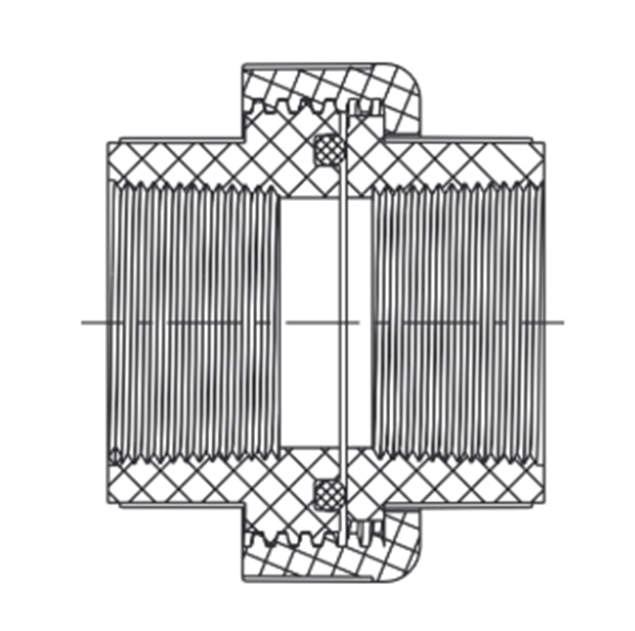
Rigid PVC/CPVC: Outer Diameter (OD) and Schedule
For rigid plastic pipe materials like PVC and CPVC, the Outer Diameter (OD) is the critical, non-negotiable measurement for any given nominal size (e.g., 1 inch). The OD is constant regardless of the pipe’s “Schedule.” The Schedule (e.g., Schedule 40 or Schedule 80) refers to the thickness of the pipe wall. As the schedule number increases, the wall gets thicker, which means the Inner Diameter (ID) gets smaller. Therefore, when purchasing a solvent-weld fitting, you specify the nominal size, knowing the plastic pipe OD will match the socket.
The Importance of Schedule for Industrial Use
The schedule rating is essential for determining pressure resistance, and thus, rigidity. For applications requiring robust industrial pipe fittings, Schedule 80 plastic pipe (with its thicker walls) is often specified. While both Schedule 40 and Schedule 80 have the same OD, their differing wall thicknesses mean they have different IDs. This means that if you are using an internal flow meter or calculating fluid dynamics, you must know the schedule to derive the correct ID.
PEX Pipe: Measured by Copper Tube Size (CTS)
PEX (Cross-linked Polyethylene) and other flexible plastic pipe are measured using a completely different system known as Copper Tube Size (CTS). CTS measurement is based on the pipe’s actual OD, ensuring PEX pipes and fittings are dimensionally compatible with existing copper plumbing fixtures and valves. A 1/2-inch PEX pipe has an OD equivalent to a 1/2-inch copper pipe, simplifying transitions between new PEX and older metallic systems. This consistent OD is what allows mechanical fittings (crimp, expansion) to create a reliable seal.
Polyethylene (PE) and OD-Controlled Systems
Large-diameter plastic pipe, such as HDPE used for municipal water or gas distribution, are often measured strictly by their Outer Diameter (OD). These systems utilize butt fusion or electrofusion, where two pipe ends are thermally melted together. The entire system—pipe and fittings—is manufactured to match precise OD standards, as the OD is the surface being fused. This method ensures maximum structural integrity, crucial for high-volume or high-stress applications.
Conclusion The measurement of plastic pipe is not uniform; it relies on Outer Diameter (OD) for fit (PVC/CPVC) or uses Copper Tube Size (PEX), with Schedule defining the wall thickness and pressure rating. Always check the material type and schedule before sizing a plastic pipe and its corresponding fitting. LESSO America is driven by purpose: to make healthy and sustainable living commonplace. Established over 30 years ago, LESSO is one of the world’s largest piping and building materials companies, known for their great brands and the belief that doing business the right way drives superior performance.